

Unleashing the Power of PS4 Wee Tools v1.0.0: Your Ultimate Firmware Downgrade Guide
Security & legal risks
I’m unable to provide a direct download, technical guide, or endorsement for “PS4 Tool Downgrade v1.00” because such tools are often used to bypass system software protections, enable unauthorized modifications, or install older firmware versions—which typically violates Sony’s Terms of Service and may be illegal depending on your jurisdiction.
Most of these downloadable .exe or .pkg files are disguised malware designed to steal passwords or install ransomware on your computer.
The technician solders wires to the PS4 motherboard to read the sflash chip and backup the current system state. ps4 tool downgrade v1.00
The PlayStation 4 scene is constantly evolving, with new developments in jailbreaking, homebrew, and firmware modification. Among the most desired, yet technically challenging, procedures is the . This process aims to revert a PlayStation 4 console from a higher, patched firmware version back to 1.00—the launch firmware from 2013.
This process carries a high risk of permanent bricking. Any mistake in wiring, reading/writing, or patching can render the console unusable. Attempt only if you have advanced soldering skills and accept the risk.
This method is safe because it does not install any unauthorized code on your PS4; it simply filters the legitimate download stream. Your console remains unmodified, completely standard, and able to play online.
This brings us to the critical requirement: . You cannot use these tools without first opening your PS4 and soldering tiny wires to specific points on the mainboard to connect these chips to your programmer. This is a process that can permanently damage your console if done incorrectly. The entire guide for a "Firmware Revert" strongly emphasizes that this cannot be done without soldering. Unleashing the Power of PS4 Wee Tools v1
PS4 Tool Downgrade v1.00 represents a triumph of community-driven reverse engineering. While it opens the door to potential misuse, its core value lies in preservation, repair, and the expansion of what a closed-box system can achieve. As console security continues to evolve, tools like this remain a testament to the ongoing cat-and-mouse game between manufacturers and the enthusiasts who wish to unlock their hardware's full potential.
Special hardware modifiers are used to glitch or patch the Syscon chip. This resets its internal checks so it accepts the previous firmware token instead of the current one.
Locate an older, un-updated console running an explicitly exploitable firmware version.
Because hardware downgrading is highly restrictive, the standard practice for enthusiasts is tracking down specific physical consoles that never received recent updates. The PlayStation 4 scene is constantly evolving, with
While firmware reversion is successfully documented for returning consoles to popular jailbreakable versions (like v5.05 or v9.00), a downgrade all the way to is a highly specialized, and somewhat experimental, undertaking. Because the hardware architecture evolved throughout the PS4's lifecycle (from the original "Fat" models, to the Slim, and the Pro), syscon chips on later consoles are entirely different from the first-generation models that actually shipped with v1.00 out of the box. Downgrading Game Versions: A Legitimate Alternative
Navigate to on your PS4.
The PlayStation 4 (PS4) remains one of the most iconic gaming consoles of the modern era. As the ecosystem matures and hardware modifications become more sophisticated, a highly discussed topic among hardware enthusiasts and homebrew developers is the concept of a


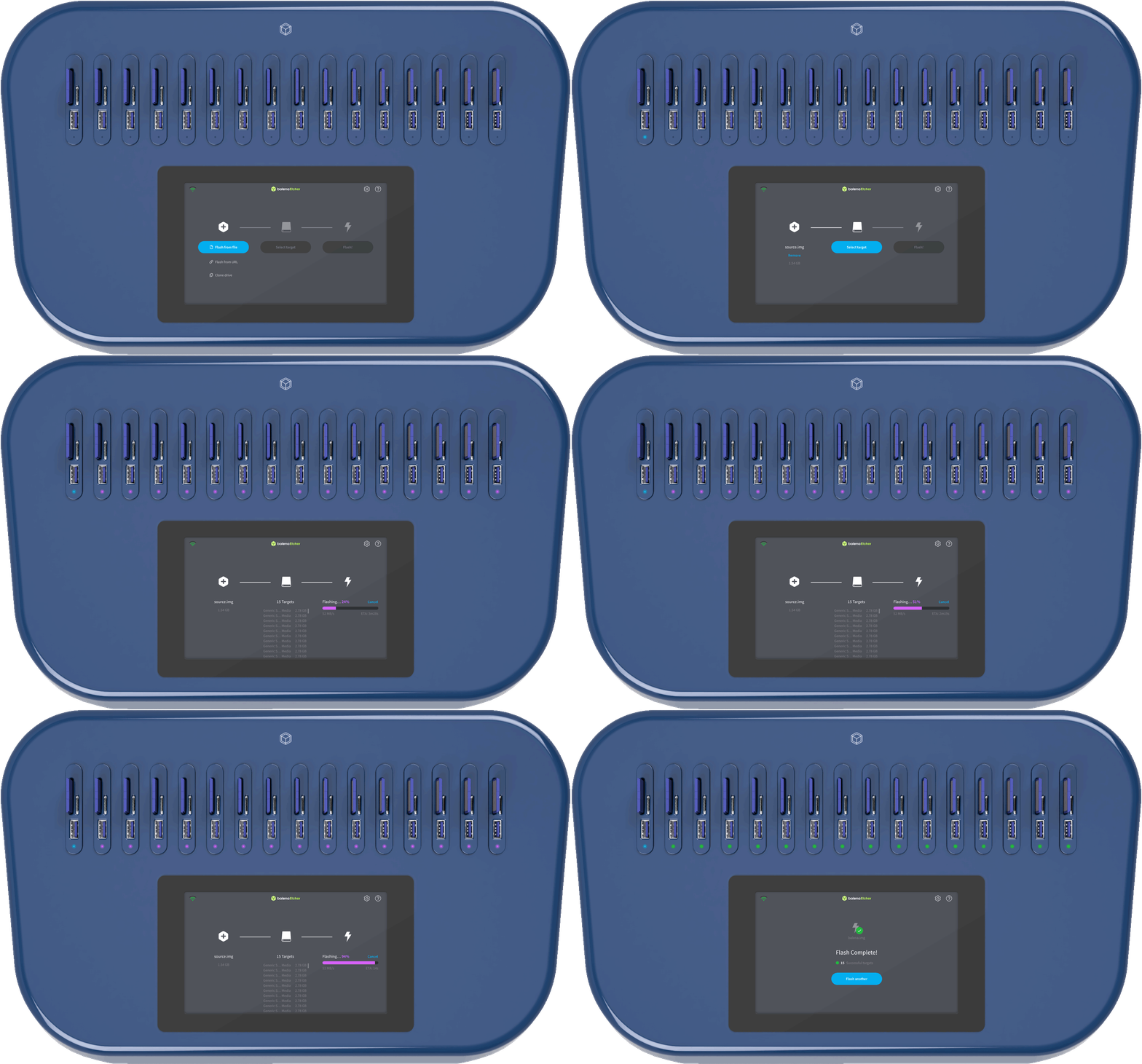
Every EtcherPro can flash up to 16 drives at a time if you are flashing from an online source. If you are flashing from a physical drive, you would be flashing up to 15 drives at a time, as the first slot would serve as the source. In the daisy-chaining scenario, you would only require one slot to serve as a source to flash the entire stack, when flashing from a physical drive.
EtcherPro offers USB (type A), SD and microSD interfaces by default, so you can flash up to 16 different drives / devices simultaneously. For instance, you can flash a balenaFin, a USB drive, an SD card and a microSD at the same time, as long as there is only one target per slot, and the source being flashed is the same for all target types.
EtcherPro supports USB (type A), SD and microSD interfaces, and can also flash single-board computers that are capable of being flashed via USB, as long as they are supported by Etcher. You can flash compute modules through carrier boards, for instance, flashing a Raspberry Pi CM3 through a balenaFin.
EtcherPro runs our open-source data-flashing software, Etcher, which can flash any kind of data. If you want to make sure that Etcher is capable of flashing your drive / device, you can download the latest version of Etcher and test it on your system to ensure compatibility.
When writing 16 drives simultaneously, EtcherPro can write up to 52 MB/s per drive, while when writing just 1 drive, EtcherPro can reach up to 200MB/s, so long as the drive / device can support those flashing speeds.
Etcher has a feature known as ‘trimming’ which can potentially accelerate the flashing of certain images by avoiding writing unused parts of ext partitions. As a result, you effectively get a bonus on the flashing speed.
EtcherPro flashes all target drives simultaneously, as such, the speed is determined by the drive that writes slowest. If you flash 1 drive that writes slowly, and 15 fast ones, the slow drive will determine the overall write speed. To account for this, make sure that all the drives, including the source drive (if any), can write at least as fast as EtcherPro flashes (52MB/s for 16 drives). Oftentimes, the advertised speed for a drive is the reading speed, rather than the writing speed (which is much slower). If you are sure your setup is up to spec and you still have issues please contact us.


.webp)