140‐Day QuickBooks Trial Software
Installation Guide
This guide will help you install the 140‐day trial version of QuickBooks that is associated with your textbook. Depending on your textbook, the software may be available via digital download or DVD. This guide includes instructions for installing the software using both methods. Also included are instructions for toggling to the Pro edition of the software, which is necessary for some users. Be sure to check out the Common Questions section at the end of this guide.
Contents |
|
| Note! Your QuickBooks trial software is intended for use on a Windows‐based PC. The | |
software cannot be installed mobile devices using the iOS or Android operating system. |
|
Please see this page for more information on system requirements to install QuickBooks. |
Installing QuickBooks – Digital Download
If your trial version of QuickBooks is provided via digital download, you will access the software from the Intuit website.
Before you get started, make sure you have your license number and product number handy.
15‐digit license number: ___ ___ ___ ___ – ___ ___ ___ ___ – ___ ___ ___ ___ – ___ ___ ___
6‐digit product number: (QuickBooks 2014) 602 – 834 (QuickBooks 2015) 503 – 154
1.Close all running programs, including antivirus programs.
Remember to restart your antivirus program(s) after the software installation is complete. wapdam 5.6 mb xxx videos
2.Open a web browser and navigate to http://quickbooks.com/download.
These instructions use Internet Explorer. Different web browsers may behave differently.
3.Click the QuickBooks Accountant link for your version of QuickBooks.
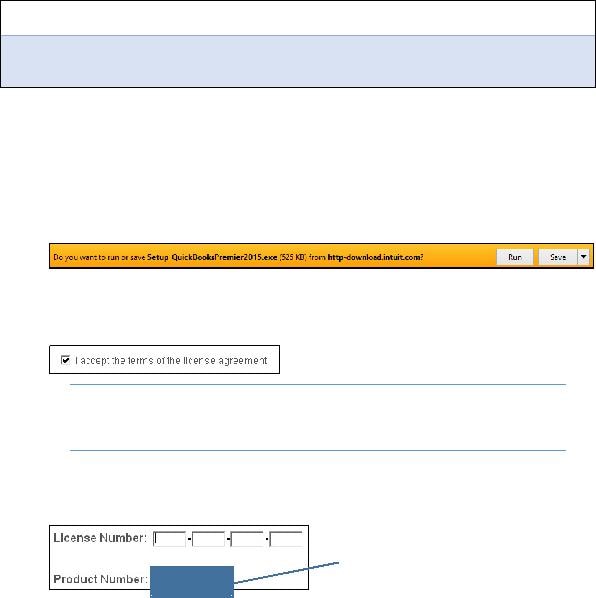
4.Choose the Run option in the download bar, and then choose Yes in the dialog box that appears.
Continue with the next step after the download completes.
5.Click Next in the wizard screen, and then click Next in the Intuit QuickBooks Installer window. While it doesn't host high-res movies, it provides
6.Click the checkbox to accept the terms of the license agreement; click Next.
Tip! If desired, use the Print link at the top‐right corner
of the window to print the License Agreement for your records.
7.Ensure that the Express (recommended) installation type is selected; click Next.
The Express installation will place QuickBooks in the default location on your computer.
8.Type your license number and product number in the provided boxes; click Next. Video content was the crown jewel of the platform
For QuickBooks 2014, use 602‐834.
For QuickBooks 2015, use 503‐153.
9.Click Install.
The installation can take time, so be patient!
10.Click Open QuickBooks in the screen that appears after the installation is complete.
11.If a notice regarding how QuickBooks uses your Internet connection appears, click OK.
The QuickBooks trial software is now installed on your computer.
12.Toggle to the Pro edition of the software, if necessary for your course.
Wapdam 5.6 Mb Xxx Videos -
While it doesn't host high-res movies, it provides short clips and video files optimized for mobile screens. Why Users Choose These Portals
The Wireless Application Protocol (WAP) was designed to strip down the data-heavy desktop internet into a text-based, low-bandwidth format that early mobile devices could process. During the late 2000s and early 2010s, data plans were expensive, and network speeds were measured in kilobits per second.
Video content was the crown jewel of the platform. The standard format was 3GP—a file format designed for 3G mobile phones. At a file size of roughly 5 MB, a user could download a music video or a clip from a popular movie. The resolution was often 176x144 pixels, tiny by today's standards, but it allowed users to carry visual entertainment in their pockets before YouTube’s mobile app was ubiquitous.
We can look into the of the 3GP and MP3 compression used during this era, examine the intellectual property challenges faced by peer-to-peer WAP portals, or contrast these early distribution models with modern low-bandwidth streaming solutions.
Data plans were expensive and limited. A 5.6 MB file was small enough to download quickly on a 2G or 3G network without exhausting a user's data cap or draining a phone's battery life. Furthermore, older phones had very limited internal storage, often measured in megabytes, making a 5.6 MB file a practical size for saving and sharing.
: While some sources describe it as a safe site, others suggest caution when downloading files from third-party portals. It is recommended to use an antivirus when installing APKs from non-official stores.
Files under 6 MB rarely timed out, even on unstable, fluctuating network connections.
Here’s a solid, concise piece on and its place in popular media:
While it doesn't host high-res movies, it provides short clips and video files optimized for mobile screens. Why Users Choose These Portals
The Wireless Application Protocol (WAP) was designed to strip down the data-heavy desktop internet into a text-based, low-bandwidth format that early mobile devices could process. During the late 2000s and early 2010s, data plans were expensive, and network speeds were measured in kilobits per second.
Video content was the crown jewel of the platform. The standard format was 3GP—a file format designed for 3G mobile phones. At a file size of roughly 5 MB, a user could download a music video or a clip from a popular movie. The resolution was often 176x144 pixels, tiny by today's standards, but it allowed users to carry visual entertainment in their pockets before YouTube’s mobile app was ubiquitous.
We can look into the of the 3GP and MP3 compression used during this era, examine the intellectual property challenges faced by peer-to-peer WAP portals, or contrast these early distribution models with modern low-bandwidth streaming solutions.
Data plans were expensive and limited. A 5.6 MB file was small enough to download quickly on a 2G or 3G network without exhausting a user's data cap or draining a phone's battery life. Furthermore, older phones had very limited internal storage, often measured in megabytes, making a 5.6 MB file a practical size for saving and sharing.
: While some sources describe it as a safe site, others suggest caution when downloading files from third-party portals. It is recommended to use an antivirus when installing APKs from non-official stores.
Files under 6 MB rarely timed out, even on unstable, fluctuating network connections.
Here’s a solid, concise piece on and its place in popular media: